What is compensatory time off? And how can it help you boost morale, manage budgets, and keep your team engaged without burning them out? Learn about the difference between comp time vs overtime and unlock a handy guide to crafting your own fair comp time policy that will benefit everyone in the company.
Ever had one of those weeks when your team is giving it their all, staying late and pushing through tight deadlines as projects pile up? You want to show your appreciation, but a simple “thank you” or a little overtime pay does not quite capture how much that effort means. That is where comp time can really shine. It gives employees a chance to trade those extra hours for real downtime, the kind that helps them reset and come back stronger.
Making it work smoothly doesn’t have to be complicated. Having a clear framework that spells out who’s eligible, how much time they can earn, and how it’s tracked and approved keeps everything fair and transparent. When your team knows the rules are simple and consistent, it makes them feel recognized, avoids confusion, and keeps the workflow running without a hitch.
On this page, you’ll discover how to calculate comp time properly, the essential compensatory time off guidelines, and a step-by-step guide for creating a policy that works for your team and your organization.
Compensatory Time Off Meaning
So, what does comp time mean? To put it simply, compensatory time off, or comp time, is an alternative way to reward employees for putting in extra hours without automatically paying overtime wages. Rather than receiving extra pay for those long days, employees earn paid time off that they can use later to rest, handle personal errands, or just take a breather.
A workplace with a comp time policy typically credits employees with PTO types based on the extra hours they’ve worked. For example, if someone works more than 40 hours in a week, those extra hours can translate into paid time off rather than additional pay. This approach gives employees flexibility while still recognizing their effort.
How Does Comp Time Work?
Deadlines pile up, evenings run long, and those “quick fixes” turn into hours of extra work. Some roles just don’t fit neatly into a nine-to-five routine. When a busy period stretches longer than expected, many teams turn to compensatory time off as a way to restore balance. It’s not just about rewarding extra effort; it’s about making sure employees get real downtime once the pressure lifts. Here’s how this system usually works in practice:
Time-off accrual
When employees put in extra hours, they build up compensatory time that can be used later. Most companies follow a one-for-one PTO policy: one hour of paid time off for each hour of overtime. Some organizations, especially during major releases, may offer a higher rate, giving extra rest time as a thank-you for pushing through high-stress periods.
Eligibility
Not all jobs qualify for comp time. It’s most often available to salaried workers, while hourly employees are generally required to be paid in cash for overtime unless certain legal conditions are met. Usually, both sides (the employer and the employee) must agree in advance that extra hours will be converted into time off rather than overtime pay.
Usage of comp time
Once compensatory time has been added to an employee’s balance, it can be used just like personal or vacation leave. The worker requests time off, and those hours are subtracted from their available time off balance. Many employers have policies that require using the earned time within a set period, such as within a year, to prevent it from expiring or being paid out later.
Limits and expiry rules
Most organizations set boundaries on how much compensatory time can be stored and for how long. These rules help keep things fair and manageable, preventing large backlogs of unused time and ensuring that employees actually take the breaks they’ve earned. It’s a way to protect both the company’s workflow and the worker’s well-being.
Conversion to pay
In some cases, if compensatory time off isn’t used within a specified period, employees can request to be compensated financially. This conversion option prevents staff from losing earned time and helps employers avoid excessive accumulations of unused hours. For example, a developer who hasn’t been able to take time off due to project deadlines might receive a payout for their remaining earned time off at the end of the fiscal year.
Keeping track of hours
Accurate record-keeping is essential for comp time to work properly. Employers usually use digital tools or HR software such as OrgaNice to log overtime and update balances automatically. Tracking compensatory time off through the same system as payroll or attendance ensures transparency and avoids confusion about who’s earned what.
Calculating compensatory time is pretty straightforward once you know the basic formula. The first step is to track how many overtime hours an employee has worked. This information usually comes from your time-tracking system.
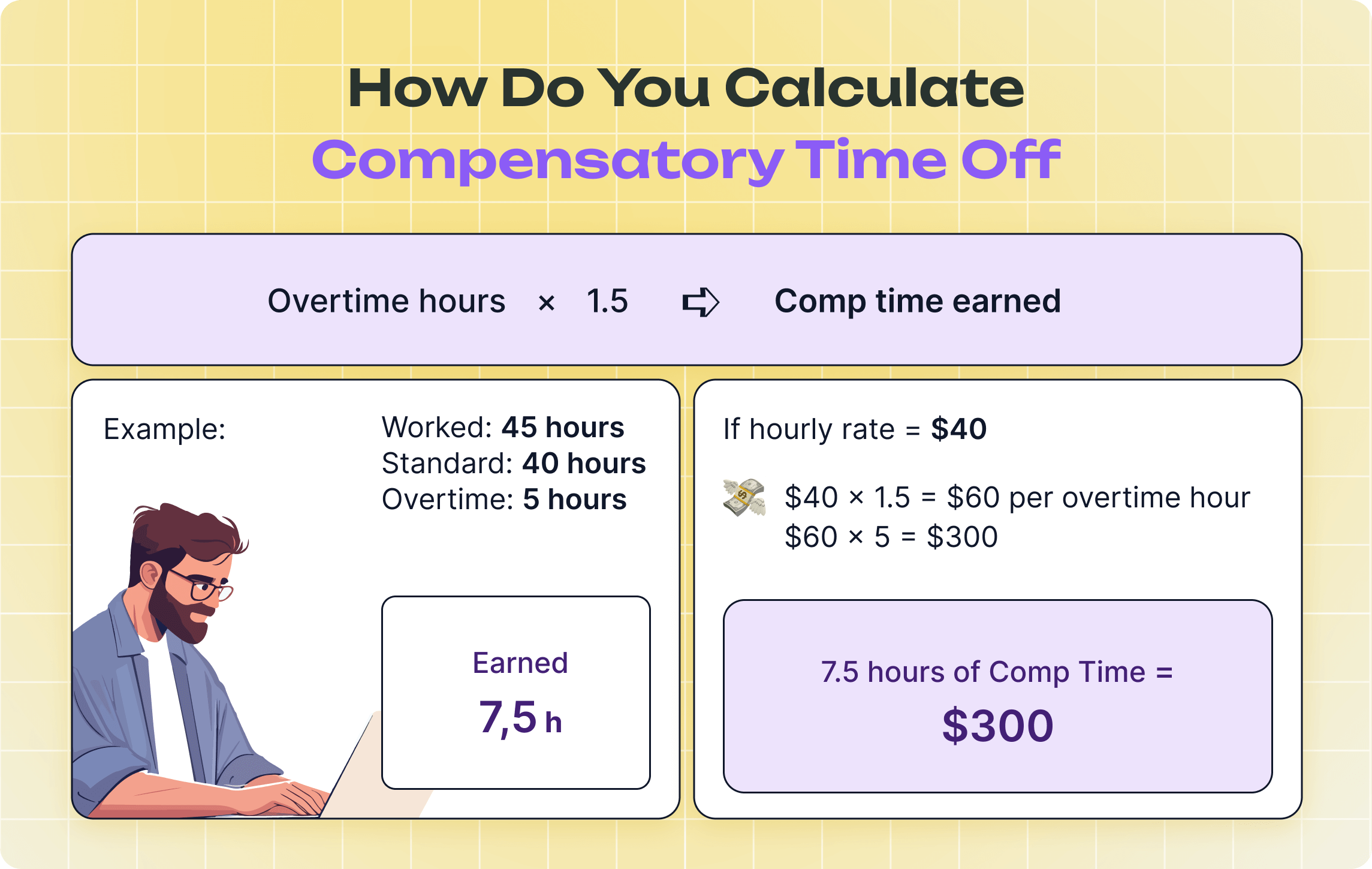
Let’s assume that in company A comp time is calculated at time and a half, meaning employees earn 1.5 hours of paid time off for every hour of overtime they work. The formula looks like this:
Overtime hours × 1.5 = Comp Time Earned
Example:
Let’s say a software engineer works 45 hours in a week instead of the standard 40. That’s 5 extra hours. To calculate the compensatory time:
5 overtime hours × 1.5 = 7.5 hours of comp time
So, the engineer earns 7.5 hours of paid time off to use later.
If the same engineer earns $40 per hour, and you want to see what that comp time equals in pay:
$40 × 1.5 = $60 per overtime hour $60 × 5 overtime hours = $300 worth of overtime pay
Therefore, the employee receives 7.5 hours of comp time, which provides equivalent value to $300 in overtime pay.
The Fair Labor Standards Act (FLSA) sets general rules about how comp time can be offered. For eligible employees, there’s often a limit of 240 hours of compensatory leave that can be accumulated, though some roles, like emergency or public service positions, may go up to 480 hours. Once that limit is reached, any additional overtime must be paid in cash.
If an employee leaves the company and still has unused compensatory time, the employer must pay out the remaining balance based on their current rate of pay. Also, for part-time staff who work less than 40 hours a week, time and a half doesn’t apply. For example, if a 30-hour-per-week employee works 2 extra hours, they would simply earn 2 hours of comp time, not 3.
Track and manage your team's compensatory time off effortlessly
Setting up a compensatory time system can be a great way to give employees more flexibility while still keeping enough staff during busy times. However, before doing so, it’s essential to understand the legal rules around overtime. To start, let’s look at how comp time and overtime differ from each other.
Overtime
Overtime means paying employees extra money when they work more than their standard hours, usually over 40 hours in a week. The extra pay rate is often “time and a half,” which means 1.5 times the regular hourly wage. This system is required by many labor laws to ensure workers are fairly compensated for putting in additional hours.
Comp Time
Compensatory time, however, works differently. Instead of receiving additional pay for extra hours, employees earn paid time off that they can use later. For example, if someone works extra hours this week, they can take that time off in the future while still receiving their regular pay.
This approach gives employees more flexibility to manage their schedules and take breaks when they need them. However, comp time comes with specific rules and limits. For instance, companies may require employees to request it in advance or cap how many hours can be banked.
Let’s go over the main differences in the comprehensive table below:
Aspect
Overtime Pay
Compensatory Time
Form of compensation
Extra pay (usually 1.5× the regular hourly rate).
Paid time off instead of extra pay (earned at 1.5 hours of time off for each hour of overtime).
When it applies
Automatically triggered once the legal work-hour threshold (usually 40 hrs/week) is exceeded.
Granted when both employer and employee agree in advance to exchange overtime pay for time off.
Regulation
Strictly regulated under FLSA; employers must pay within the next regular pay period.
Subject to federal and state rules; often capped (e.g., 240 hours max accrual for public employees).
Employer advantages
Predictable cost structure; motivates employees to work during busy periods.
Helps manage staffing levels without increasing payroll expenses.
Compensatory Time Off Guidelines
Wondering who actually qualifies for compensatory time? Here’s the deal. Whether you can earn it depends on your job type and the organization you work for.
Under the Fair Labor Standards Act (FLSA), comp time for exempt employees is not permitted, as exempt positions are not subject to overtime requirements. That doesn’t mean your extra effort goes unnoticed, employers can still reward you with extra vacation days, personal time, or discretionary bonuses. However, direct time off in exchange for extra hours isn’t allowed.
On the other hand, comp time for non-exempt employees follows a different set of rules. These employees can generally earn 1.5 hours of paid time off for every overtime hour worked. Employers should give staff a fair chance to use their accrued time within a reasonable period, and any compensatory time taken is paid at the regular hourly rate. Having clear procedures for requesting and approving comp time helps keep the system fair and consistent for everyone.
Compensatory time rules also differ depending on whether you work in the private or public sector. In the private sector, employers generally have to pay overtime for nonexempt employees and have limited ability to offer comp time. Additional benefits, like vacation or personal days, can be offered, but they typically cannot replace overtime pay.
On the flip side, public sector employers, including government agencies and some nonprofits, may give compensatory time in place of overtime pay, usually at a 1.5-to-1 ratio. These organizations must follow rules around accrual, maximum balances, documentation, and timelines for using the time.
When you work extra hours, you build up comp time that can be used later, similar to vacation or personal leave. Some companies follow a one-for-one policy, while others may offer slightly more during busy periods as a way to thank employees for going the extra mile. Not all roles qualify, and most of the time, both the employee and employer must agree in advance if overtime will be converted into time off rather than paid.
Writing a comp time policy isn’t just about keeping the HR gods happy, it’s about keeping your team sane when work gets wild. A well-designed policy makes sure extra effort today turns into real rest tomorrow. And just like you track vacation time or monitor sick days, it’s essential to track compensatory time off too because time earned should be as visible and well-managed as time taken. To make that easier, we’ve put together the key steps for crafting a policy that actually works.
Define Eligibility Criteria
You should be very clear about which employees are eligible to earn compensatory leave. Typically, this applies to specific groups, such as salaried staff classified as FLSA-exempt in the US, or full-time employees rather than contractors. In most situations, non-exempt hourly employees are required to receive overtime pay for extra hours and generally cannot accrue compensatory time, except under certain special conditions.
Moreover, it’s important to make sure eligibility rules align with legal requirements, which can differ depending on whether the organization is in the private or public sector. Additionally, the policy should define the types of extra work that qualify for comp time. For example, is it only for hours worked beyond the standard workweek, or does it also include work on weekends and holidays? Some companies choose to treat these situations differently, and clarifying this in the compensatory time off policy helps avoid confusion.
Set Up Accrual Rules and Expiration Dates
It’s crucial to specify how comp time is earned and how it adds up. Some companies keep it simple, giving one hour of compensatory time for each extra hour worked, while others might use a 1.5-to-1 ratio for overtime. The rate can also vary depending on the situation.
For instance, hours worked on a regular weekday might be counted one-for-one, but extra hours on weekends or public holidays could earn more to reflect the inconvenience of working outside normal hours.
Consistency is crucial. Applying the same rules to everyone helps avoid confusion or feelings of unfairness. Providing examples can make it easier to understand, such as: “If you stay two hours late on a Tuesday, you’ll get two hours added to your time off balance.” It’s also useful to define how time is tracked, including the smallest increments recorded, for example, some systems measure extra time in 15-minute blocks to keep things precise.
Establish Request Procedures
It’s useful to clarify how employees can take their comp time. In most organizations, it works similarly to regular vacation or PTO, where employees submit requests through the HR system or get manager approval. Like any other leave, any time off earned for extra hours should be scheduled with business needs in mind to ensure operations continue smoothly.
Managers should have a clear understanding of how to approve compensatory time fairly, so employees feel confident that their requests are handled consistently. If there are any periods when taking compensatory time isn’t allowed such as during busy seasons or critical project phases, these should be communicated upfront. The goal is to strike a balance: giving employees the opportunity to enjoy the time they’ve earned while keeping the organization running effectively.
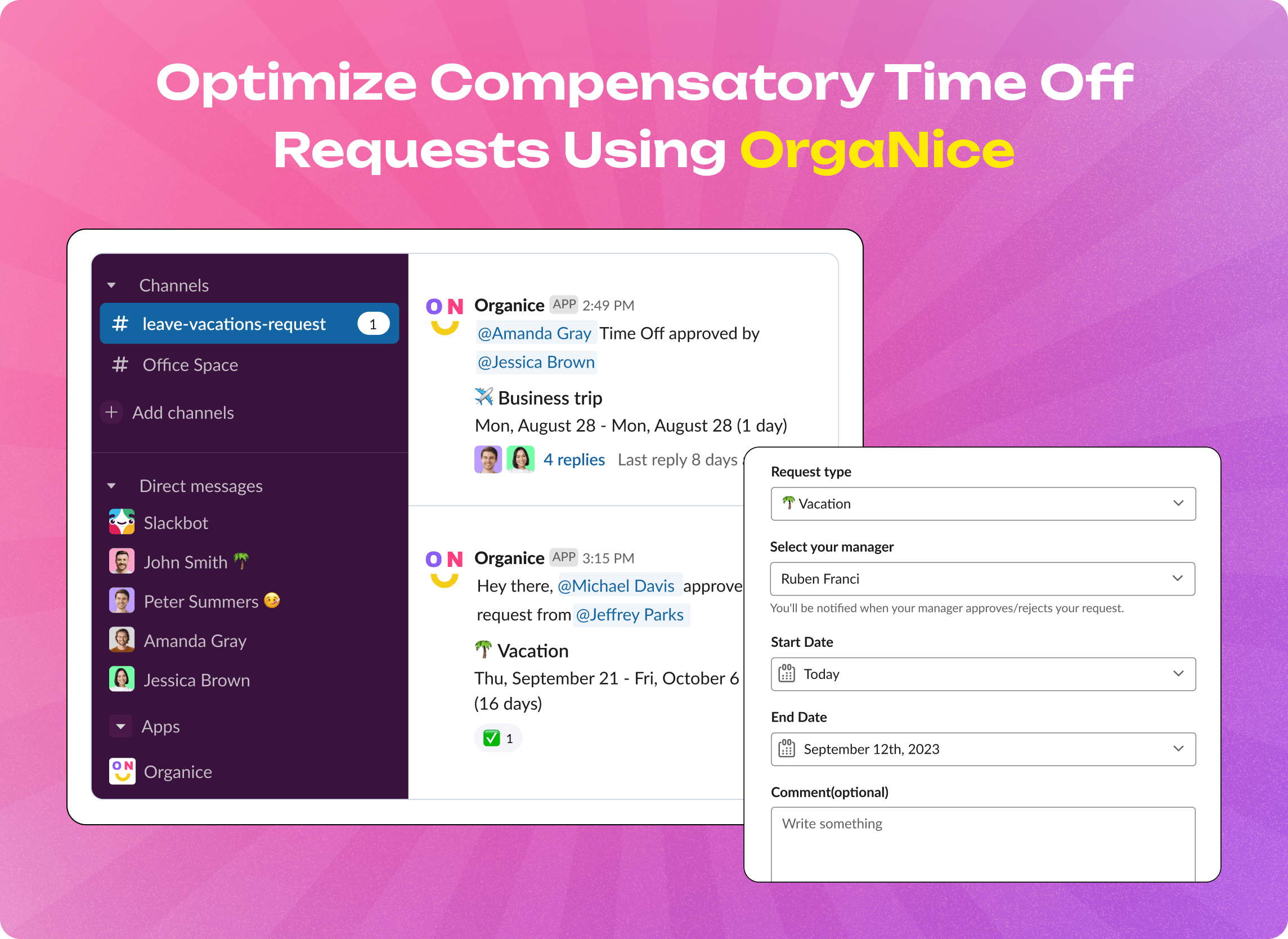
And of course every team needs a clear, reliable way to track absences and paid time off. OrgaNice time off and vacation tracker makes that process almost effortless. It’s a smart, fully integrated time off and vacation tracker that works right where your team already communicates, eliminating the need for extra tools or constant context switching.
With OrgaNice, setting up and managing leave policies takes minutes. You can handle PTO requests, automate approvals, and keep everything stored in one place. The result? Faster workflows, fewer mix-ups, and more transparent communication across your team.
Here’s what you can do with the OrgaNice bot:
customize it to match your company’s PTO and leave policies;
create simple, flexible request forms with fields like time-off type, manager, dates, and comments;
submit requests directly in Slack with one click via the “Request Time Off” button;
automate approval workflows, so managers get notified instantly in Slack when requests come in;
keep everyone in the loop with automatic notifications in a chosen Slack channel, so the team can discuss coverage or share updates;
track all absences in one place, including past and upcoming leaves, categorized by type;
check balances instantly, therefore, employees and managers can always see how much time off remains;
add a touch of fun: when someone’s on leave, an emoji (like a palm tree) automatically appears in their Slack status;
keep your calendar current, with automatic updates for birthdays, holidays, anniversaries, and approved leaves;
generate quick reports on absences, patterns, and time-off usage in just a few clicks.
Best of all, you can try OrgaNice free for 14 days, and after that, it’s just $1.25 per employee per month (with extra savings if billed annually). That price covers not only the time-off tracker but also other great tools, including an AI-powered org chart, employee feedback surveys, the birthday bot, the kudos bot, and more.
Communicate and Review Policy for Legal Compliance
A comp time policy only works when employees actually understand it. It’s helpful to provide a written version like in the employee handbook or on the intranet and, if possible, offer an informational session or Q&A to walk through the details.
Managers play an important role too. When overtime occurs, they can remind their teams that taking time off instead of overtime pay is an option and explain how it works. Open communication and occasional training help ensure the policy is applied fairly, consistently, and seen as a genuine benefit rather than just another rule.
Triple your PTO management efficiency with OrgaNice
Concluding Thoughts on Compensatory Time Off Management
Managing comp time effectively is all about balance. When policies are clear, fair, and communicated well, employees can feel confident using the time they’ve earned, and managers can keep operations running smoothly. A thoughtfully designed system makes sure extra effort is recognized, prevents misunderstandings, and supports both employee well-being and business needs.
Using tools like OrgaNice makes handling extra hours and time off effortless. The platform lets you log and approve extra hours, convert them into compensatory time off, and keep balances visible to both managers and employees. With everything updated automatically and stored in one place, OrgaNice removes the hassle of manual tracking and endless email threads. Don’t be shy to reach out to us if you have any concerns – we’re here for you!