Product Team Structure: Roles, Org Charts, and Best Models for Growing Teams
Dec 11, 2025
updated on:
•
14 min
written by
Mila Dliubarskaya
Building a solid product team structure is essential for scaling, yet many companies struggle to balance clear roles, ownership, and collaboration as they grow. This guide breaks down the key product roles, shows how org charts evolve, and compares the best team models to support fast, flexible product development.
Growing a product team can feel a bit like reorganizing your kitchen while you’re cooking a five-course meal: everything’s moving, everyone needs something, and suddenly you realize no one knows who’s responsible for what. That’s the real pain point behind shaping an effective product management team structure: you’re building order and clarity while the business keeps racing ahead. Without that structure, even strong teams end up duplicating work, missing signals, or stepping on each other’s toes.
A well-crafted product team org chart becomes more than a diagram, it’s a framework that helps people do their best work. Product managers gain space to think, designers get clearer direction, and engineers finally stop juggling conflicting priorities. It’s the organizational equivalent of labeling the drawers in a once-chaotic kitchen: suddenly, the team moves with far more purpose and far fewer surprises.
The goal isn’t to copy a trendy model but to design a structure that truly fits your product, your workflows, and your stage of growth. On this page, we’ll break down the key reasons why a strong product team organizational chart matters, highlight the five most effective team structures, and walk you through how to create your own in just five steps.
Product Team Structure: Definition, Importance, and Main Types
A clear product team org chart is the backbone of any successful product organization, shaping how people collaborate, make decisions, and deliver value. When the structure aligns with the way your team works, productivity rises and confusion drops. Let’s explore what product management team structure means, why it matters, and the main ways companies approach it.
What Is a Product Team Structure
A product team structure is the way a company organizes its product team so everyone knows who does what, how decisions are made, and how work moves forward. In simple terms, it’s the framework that helps a team build and improve a product efficiently.
This setup should match the product’s stage of development, the culture of the company, and the complexity of the solution itself, whether the team works on growth, platform, or core product features. As the product grows or changes, the structure may also shift to support new priorities, different levels of coordination, or expanding areas of ownership.
Why Product Team Organizational Structure Matters
A product team organizational structure is like the blueprint of a house. Without it, everyone might be building walls in different rooms, installing doors where there should be windows, and arguing over who owns the kitchen.This framework shapes collaboration, communication, and decision-making, helping teams navigate complexity and stay coordinated as the product and organization grow.
Key advantages include:
Clarifiesroles and responsibilities, so no one ends up “painting the same wall twice”;
Alignsthe team around strategic priorities, keeping everyone pulling in the same direction;
Preventsduplicated efforts and conflicting decisions by establishing clear ownership;
Ensuresconsistent communication across teams and stakeholders, avoiding “lost in translation” moments;
Supportsscaling the team and product without chaos or bottlenecks;
Enables faster adaptation to changes, market demands, or evolving product requirements.
There’s no one-size-fits-all when it comes to organizing a product team. The right structure depends on your products, customer needs, business goals, and the resources available. Thinking about your team setup early can make it much easier to coordinate work, avoid confusion, and ensure everyone knows how they contribute to building great products.
Typically, a product leader guides a cross-functional team through every stage of the product lifecycle, from brainstorming and roadmap planning to working with engineering and other teams to deliver the right features. Here’s a quick overview of some common ways organizations structure their product teams:
Product Team Structure
Description
By product (or product line)
A product leader manages initiatives for a specific product or product line, conducting customer research, maintaining the roadmap, and working with engineering to deliver new functionality. Ideal for large organizations with multiple offerings.
By product feature
Each product leader focuses on a specific feature and coordinates with other PMs on dependencies. The CPO ensures overall cohesion. Useful for organizations with complex products.
By cross-functional collaboration (product squads)
Teams include a product owner/manager, developers, QA, and sometimes a coach or scrum master. This agile-friendly setup allows small squads to own end-to-end delivery. Suitable for large teams with resources for multiple squads.
By customer segment
Product managers are assigned to different customer groups (e.g., enterprise vs. SMB), each with unique needs. Works well when products serve diverse markets.
By customer journey stage
Product managers focus on specific phases of the customer journey, such as onboarding, adoption, or retention. Best for organizations with mature products and the resources to optimize each journey stage.
By performance metrics
Product leaders are accountable for specific KPIs or goals across product features. Suitable for mature products where measurable results drive prioritization.
By agile development methodology
Team structure aligns with the chosen methodology, e.g., Scrum (product owner, scrum master, development team) or Scaled Agile Framework (roles organized across team, program, and portfolio levels). This ensures the structure supports the development approach effectively.
Every product team is a bit like a well-rehearsed band: everyone plays a different instrument, but together they (hopefully) create something users actually want to listen to. Without clear product team responsibilities, though, the whole thing can quickly turn into a noisy jam session where nobody knows who’s leading, who’s improvising, and who accidentally unplugged the speakers.
So, let’s check out the main product team roles and their responsibilities to understand who plays which part and how all these roles work together to keep the product in tune.
Product Manager (PM)
A product manager is the strategic driver of the product. They define the product’s direction, align stakeholders, and make sure the team is building the right thing for the right audience. The PM connects business goals, user needs, and technical possibilities into a cohesive product plan.
Key responsibilities:
Leading product vision, strategy, and roadmap;
Prioritizing features based on impact and feasibility;
Communicating with stakeholders across the organization;
Gathering and analyzing customer and market insights;
Ensuring alignment between business goals and product decisions.
Product Owner (PO)
A product owner focuses on the execution side of product development. While the PM defines what and why, the PO ensures the team understands how and when. They manage the product backlog and work closely with engineering to keep development on track.
Key responsibilities:
Managing and refining the product backlog;
Writing clear user stories and acceptance criteria;
Supporting the development team during sprints;
Making day-to-day decisions about scope and priorities;
Ensuring the delivered work matches the product goals.
UX/UI Designer
A UX/UI designer is responsible for shaping how users experience the product. They combine user research, interaction design, and visual design to create interfaces that are intuitive, accessible, and visually appealing.
Key responsibilities:
Conducting user research and usability testing;
Creating wireframes, prototypes, and design systems;
Designing intuitive interfaces and user flows;
Collaborating with PMs and engineers to align on requirements;
Ensuring visual and interaction consistency across the product.
Engineers turn requirements and designs into a functional product. They build new features, maintain existing ones, and ensure the product is reliable, scalable, and technically sound.
Key responsibilities:
Writing clean, maintainable code;
Implementing new product features;
Fixing bugs and improving performance;
Collaborating with the team on technical planning;
Ensuring product reliability, security, and scalability.
Quality Assurance (QA) Specialist
A QA specialist ensures the product works as expected before it reaches users. They test functionality, identify issues, and reduce the risk of delivering buggy or incomplete solutions.
Key responsibilities:
Creating and executing test plans;
Identifying, documenting, and tracking bugs;
Performing manual and automated testing;
Validating that new features meet requirements;
Ensuring overall product quality at every release.
Marketer
A product marketer helps bring the product to market and ensures it resonates with the right audience. They craft messaging, support launches, and work on customer acquisition and retention strategies.
Key responsibilities:
Shaping product positioning and messaging;
Planning and executing go-to-market strategies;
Supporting product launches with campaigns and content;
Analyzing customer behavior and market trends;
Collaborating with sales and customer success teams.
5 Most Effective Product Team Organizational Structures
How you structure your product team shapes everything from the speed of decision-making to the clarity of ownership and the quality of what gets shipped. There’s no universal template, but there are proven approaches that help teams stay aligned, focused, and set up for predictable delivery.
Below are five efficient types of org charts for product teams. Each offers a different way to distribute responsibilities, define ownership, and support the broader product strategy. Let’s explore them one by one.
Functional Product Team Structure
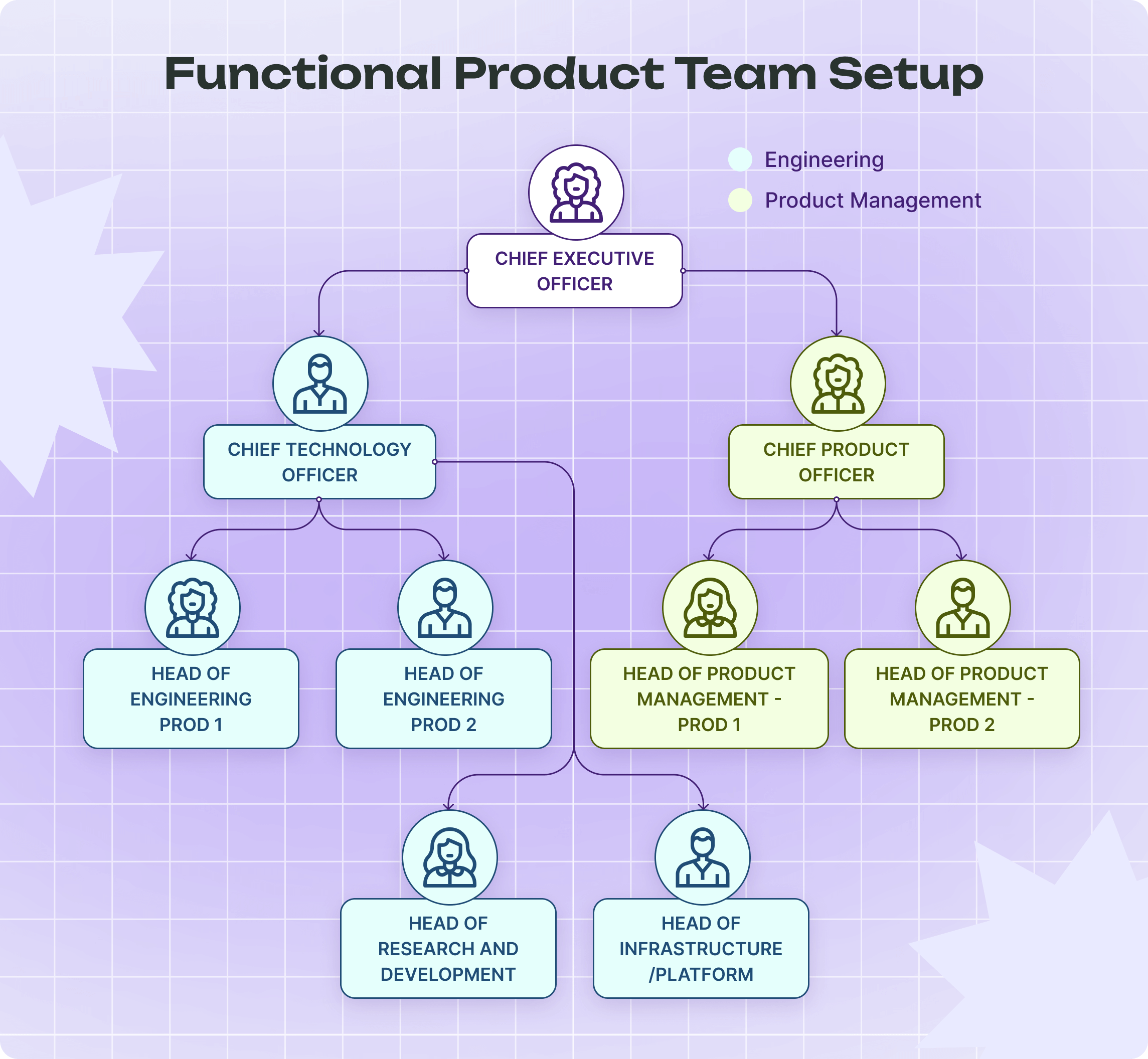
In a functional structure, team members are organized by their discipline (like engineering, design, and others). Each department operates with its own leadership, processes, and standards, while product work moves between these groups as needed. This setup strengthens expertise within each function and ensures consistent quality across the organization.
For example, a product manager might outline a new feature, then pass it to design for wireframes, engineering for development, and marketing for launch support. Each team handles its part while reporting to its functional lead, not the product manager. This works well when processes are clear, but it can slow things down if teams become too siloed or rely heavily on sequential handoffs.
Pros:
Builds deep functional expertise and consistent standards;
Provides clear reporting lines and structure;
Works well for organizations focused on specialization.
Cons:
Can slow delivery due to multiple handoffs;
Increases the risk of silos and misalignment;
May reduce cross-functional collaboration.
Cross-Functional Product Structure
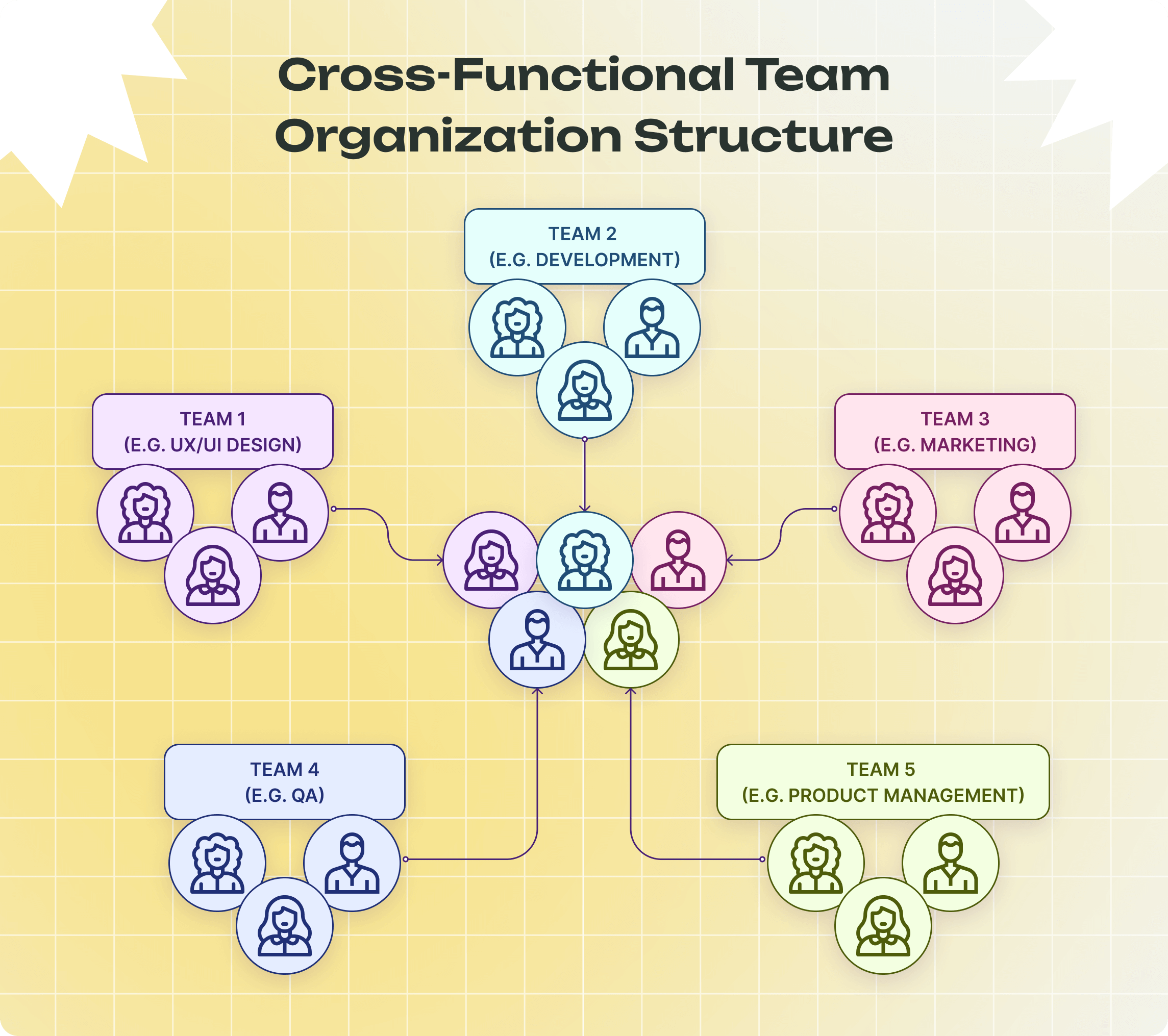
This structure centers on small, autonomous teams that fully own a specific part of the product whether a feature, workflow, or user group. Each squad contains all the expertise needed to deliver end-to-end outcomes, including product managers, designers, engineers, analysts, and sometimes QA or data specialists. They set their own priorities, manage their backlog, and follow agile practices that fit their workflow, allowing them to move independently without heavy top-down control.
Squad-based teams are a strong fit for organizations that value speed, experimentation, and continuous delivery. Startups and agile-focused companies often adopt this model because it reduces dependencies, limits bottlenecks, and allows teams to ship improvements quickly without waiting for multiple layers of approval.
Pros:
Encourages fast decision-making and high autonomy;
Creates strong ownership of a focused product area or user problem;
Enables teams to deliver complete, end-to-end solutions efficiently.
Cons:
May lead to “team islands” if communication across squads isn’t actively maintained;
Can result in inconsistent UX or technical approaches without shared standards or governance.
Product-Based Org Team Structure
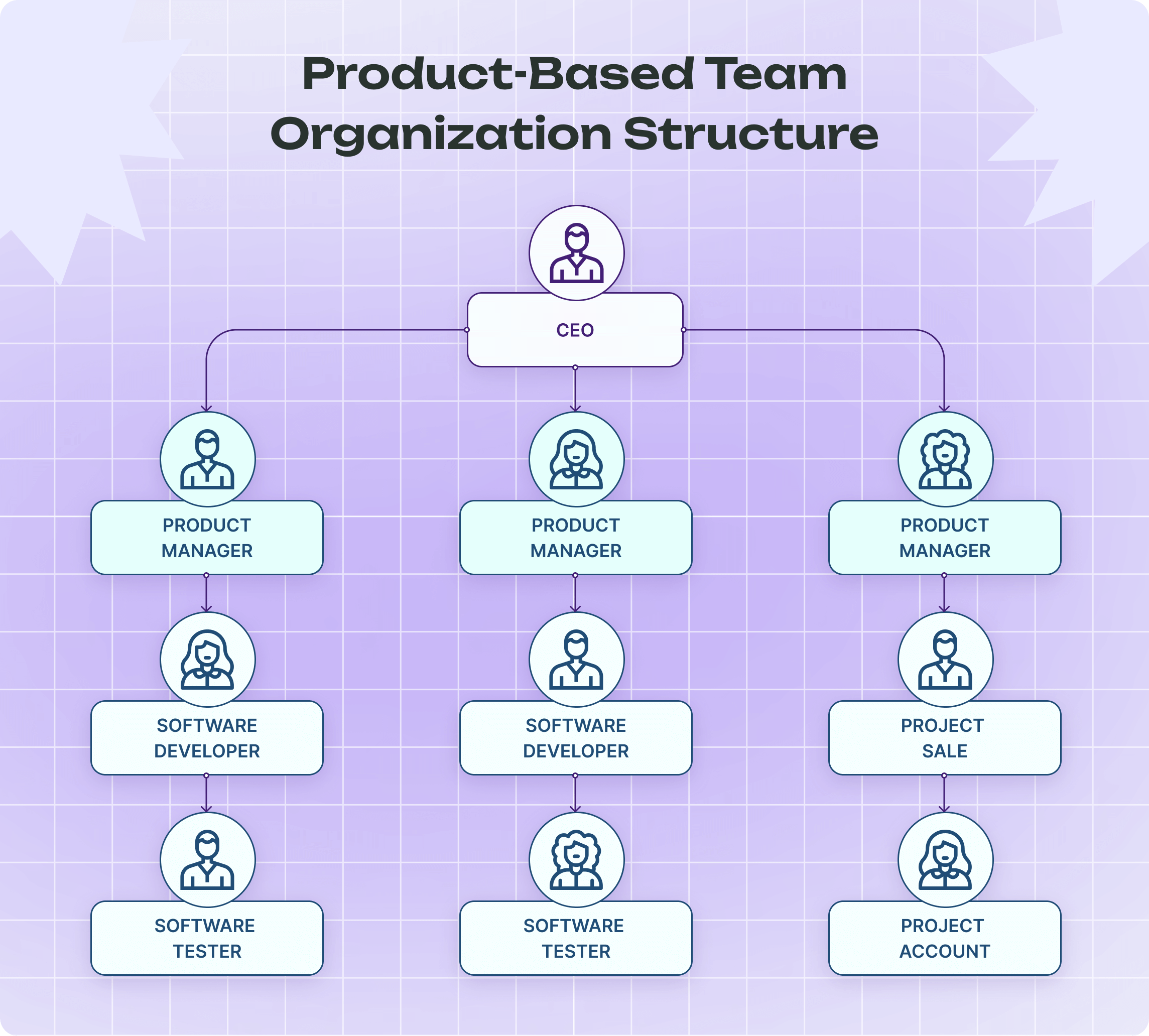
In a product-line structure, each team is dedicated to a single product or a full product line and owns it end to end. Instead of splitting work by function or feature, the entire team focuses on the success, improvements, and long-term strategy of one specific offering. This setup works especially well for companies with multiple products or large, complex solutions that require dedicated attention and deep domain understanding.
For example, a company with three major software products might have three separate product teams, one for each product line. Each team includes its own product manager, designers, engineers, and analysts who focus solely on their assigned product. They handle everything from roadmap planning to feature delivery and ongoing optimization.
Pros:
Creates strong ownership and accountability for product outcomes;
Builds deep domain expertise within each team;
Works well for organizations with multiple products or large product ecosystems.
Cons:
Can lead to duplicated effort across product teams;
Requires strong alignment to maintain consistency across the product portfolio;
May create resource imbalances if some products need more support than others.
Feature-Based Product Team Structure
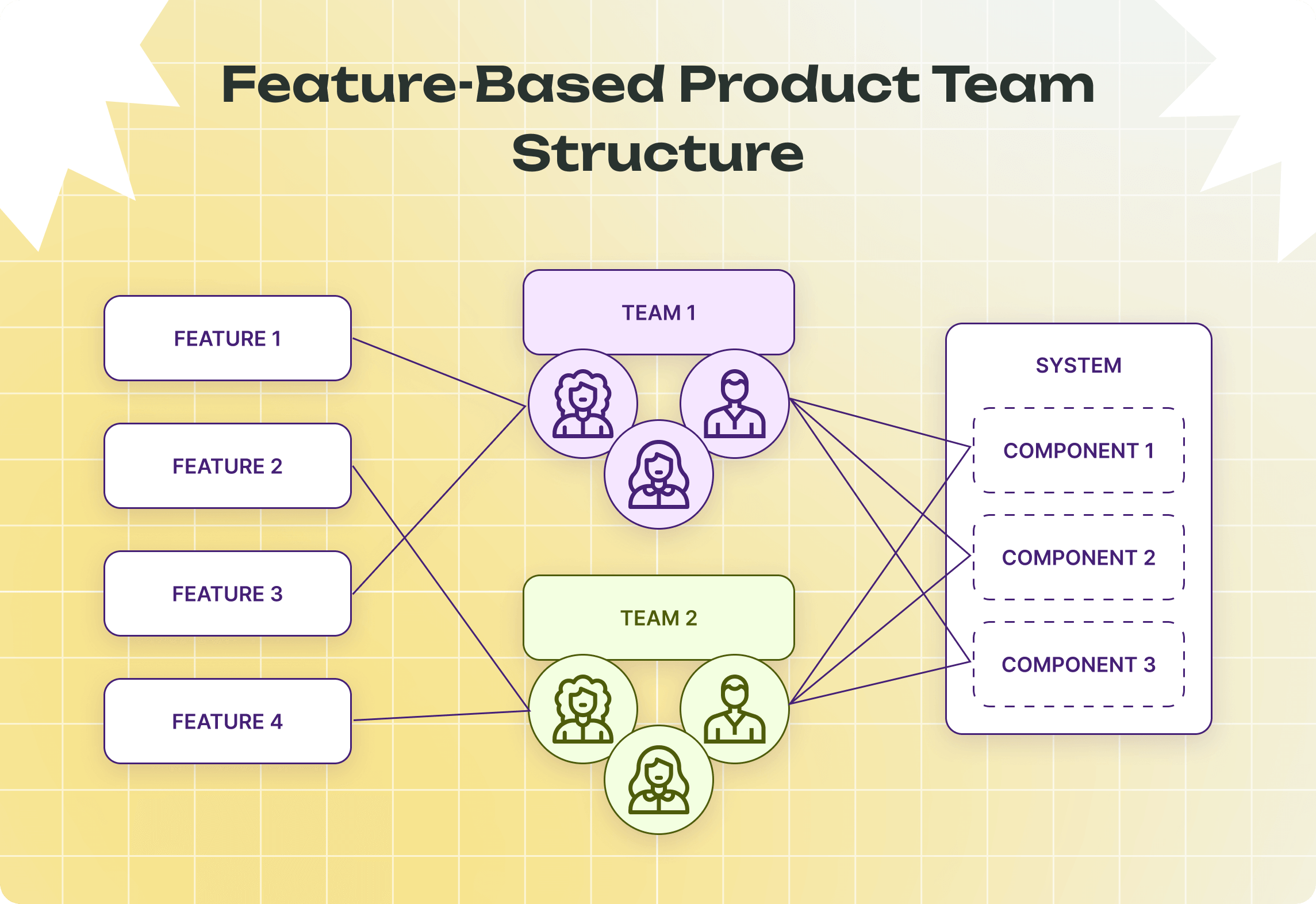
This structure assigns each team to a specific feature or module, such as search, payments, or onboarding. Teams become specialists in their area, focusing on improving functionality, fixing issues, and driving performance within that defined scope. It’s a strong fit for complex products where different components require deep technical or UX expertise.
For example, a dedicated “Payments” team might own checkout flows, payment methods, and integrations. They move quickly within their domain but must coordinate with other teams to ensure consistent user experiences and prevent conflicting changes.
Pros:
Builds deep, focused expertise within each product area;
Enables fast iteration within a well-defined scope;
Ideal for complex products with many interconnected parts.
Cons:
High coordination needed to maintain consistency across modules;
Teams may become siloed and overly focused on their own feature;
Dependencies between modules can slow progress.
Matrix Product Team Structure
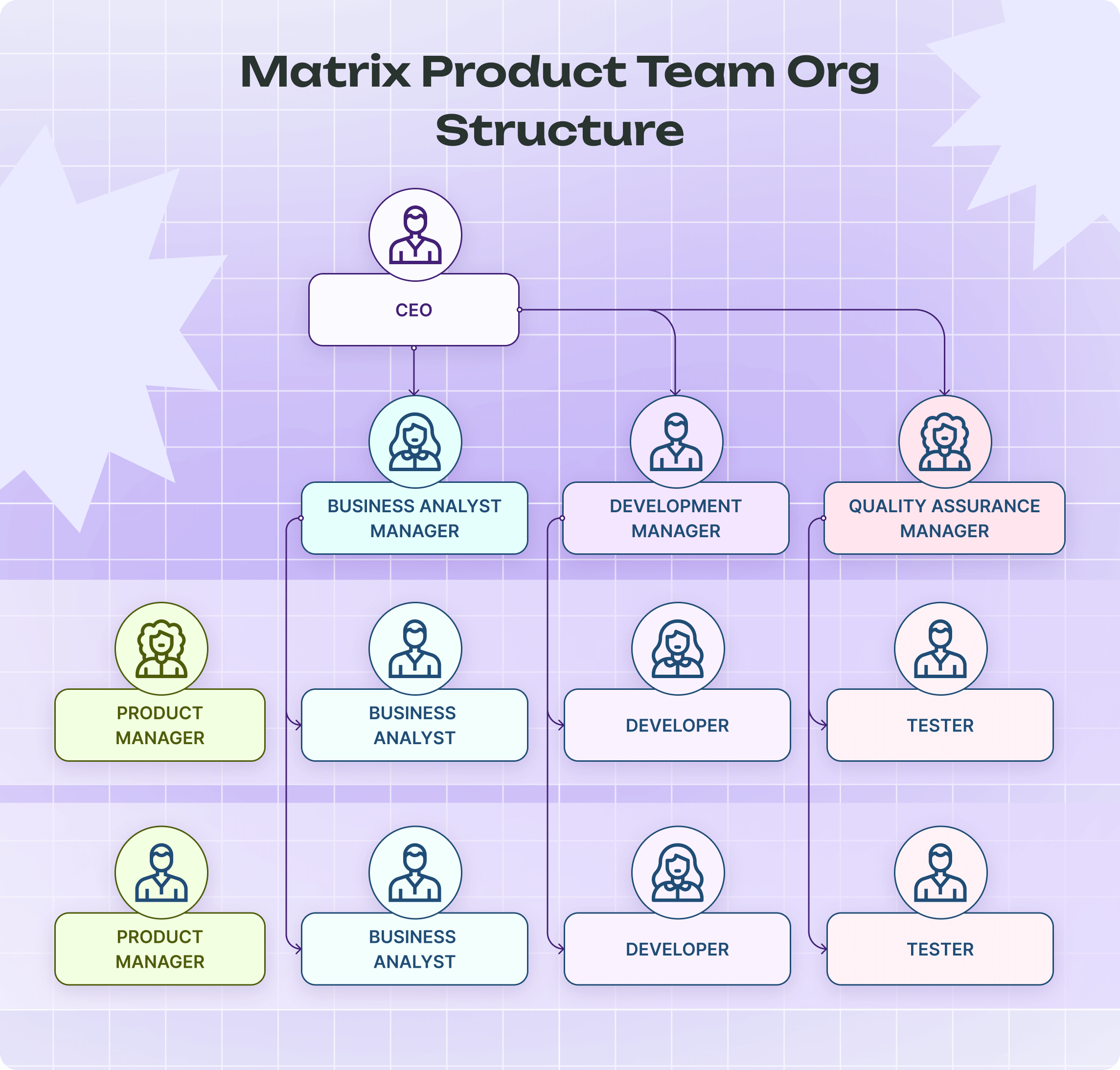
In a matrix setup, every team member works under two reporting lines at the same time – one functional and one project-based. For example, imagine a front-end developer who is part of the Checkout product team. They report to the Product Manager for day-to-day work, priorities, and delivery expectations. But they also report to the Engineering Lead, who guides their technical growth.
This approach is common in larger companies where specialized roles need to support multiple initiatives without losing touch with their discipline. Team members spend part of their time focused on product outcomes and part of their time collaborating with their functional group on methods, best practices, or shared improvements.
Pros:
Encourages strong specialization and cross-team knowledge sharing;
Supports flexible allocation of experts across multiple projects;
Maintains consistent functional standards while driving product progress.
Cons:
Dual reporting can create confusion or conflicting priorities;
Extra alignment points may slow down decisions if not well coordinated.
How to Build the Right Product Team Structure in 5 Steps
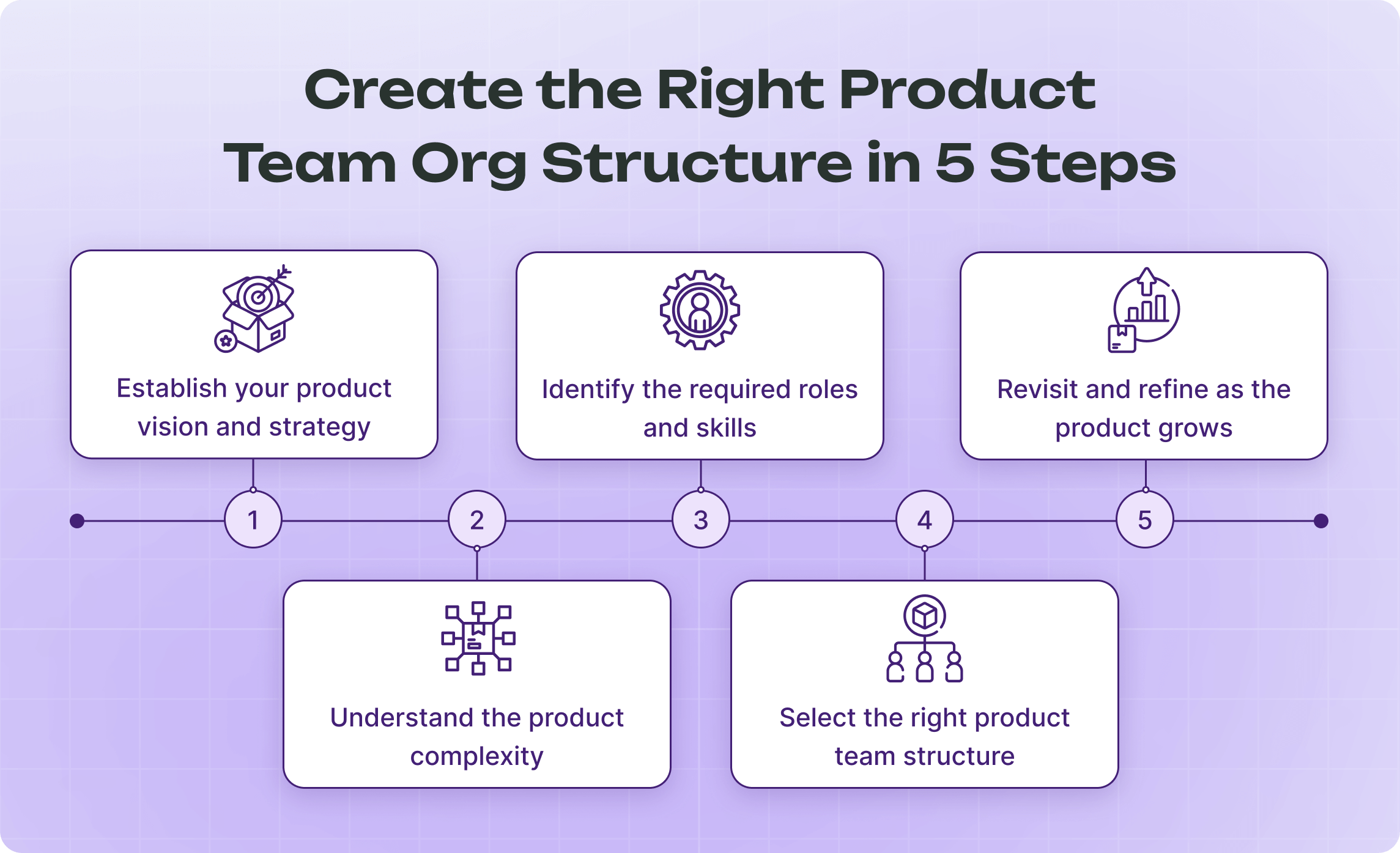
Building the right product team isn’t just about hiring smart people, it’s about putting them in the right seats and making sure everyone knows how their work fits together. If your team feels a bit chaotic, or if you’re scaling quickly and want to avoid the classic “too many cooks” scenario, it’s worth stepping back to rethink how to organize a product management team in a way that brings clarity instead of confusion. Let’s unlock how to create an org chart that makes responsibilities obvious and communication smoother.
1. Establish Your Product Vision and Strategy
According to org chart best practices, before shaping any team structure, you first need a clear picture of where your product is headed and why. Start by clarifying the big-picture vision, the strategy for getting there, and the business results your company expects the product to deliver. You should make sure you can clearly answer the core questions:
Product vision: What is the long-term future you want the product to achieve?
Product strategy: How do you plan to move toward that vision step by step?
Business goals: How will the product contribute to revenue, growth, or other key company targets?
2. Understand the Product Complexity
After that, you need a solid grasp of how complex your product really is. Not all products demand the same setup, as a simple tool with a narrow feature set might thrive with a lean, cross-functional team, whereas a large platform with multiple user groups, integrations, and technical layers will need more specialized roles and possibly multiple teams.
The level of complexity shapes everything: how many people you need, which skills matter most, how teams collaborate, and how responsibilities should be divided. As you assess complexity, consider factors like the number of features, technical architecture, customer segments, the pace of change, and the product’s long-term roadmap.
3. Identify the Required Roles and Skills
Once you understand where your product is going and how complex it is, it’s time to outline the talent required to actually build and maintain it. Start by mapping out all the core roles your product team will rely on (e.g. product managers, designers, engineers, etc.), and any specialty roles unique to your industry (e.g., compliance experts, solution architects, data scientists). Think not only about titles, but about the specific skills and responsibilities each person needs to bring to the table.
From there, decide which capabilities must be embedded full-time in each team and which can function as shared resources across multiple squads. This step helps you avoid two common pitfalls: teams struggling because critical expertise is missing, or the opposite, ballooning headcount with roles that aren’t actually needed full-time.
4. Select the Right Product Team Structure
Now it’s time to choose the structure that genuinely supports how your product works. A suitable structure for your organization ultimately depends on how your company operates, the size of your team, and the level of product team hierarchy you need. These guidelines can help you align your structure with reality:
Afunctional setup works well when your product relies heavily on specialized expertise and strong discipline-led processes.
Asquad-style model fits best if you need rapid iteration, autonomy, and minimal dependencies.
Aproduct- or product-line approach is ideal when you manage multiple offerings and want clear leadership over each one.
Afeature-based structure makes sense for complex products that benefit from teams owning distinct workflows or technical components.
Amatrix structure is effective when you need both functional depth and product alignment,especially in larger organizations.
Once you’ve chosen the right structure, the next challenge is visualizing and maintaining it without drowning in spreadsheets. Sure, you can start with templates or drag-and-drop builders, they look nice and work fine at the beginning. But they all share the same headache: someone has to keep updating them manually.
And as teams grow or shift, that becomes a never-ending chore. Using more flexible visualization formats, including inverted charts that highlight bottom-up relationships and real ownership flows, can help you see your structure more clearly, but even they become hard to maintain if everything has to be updated by hand.
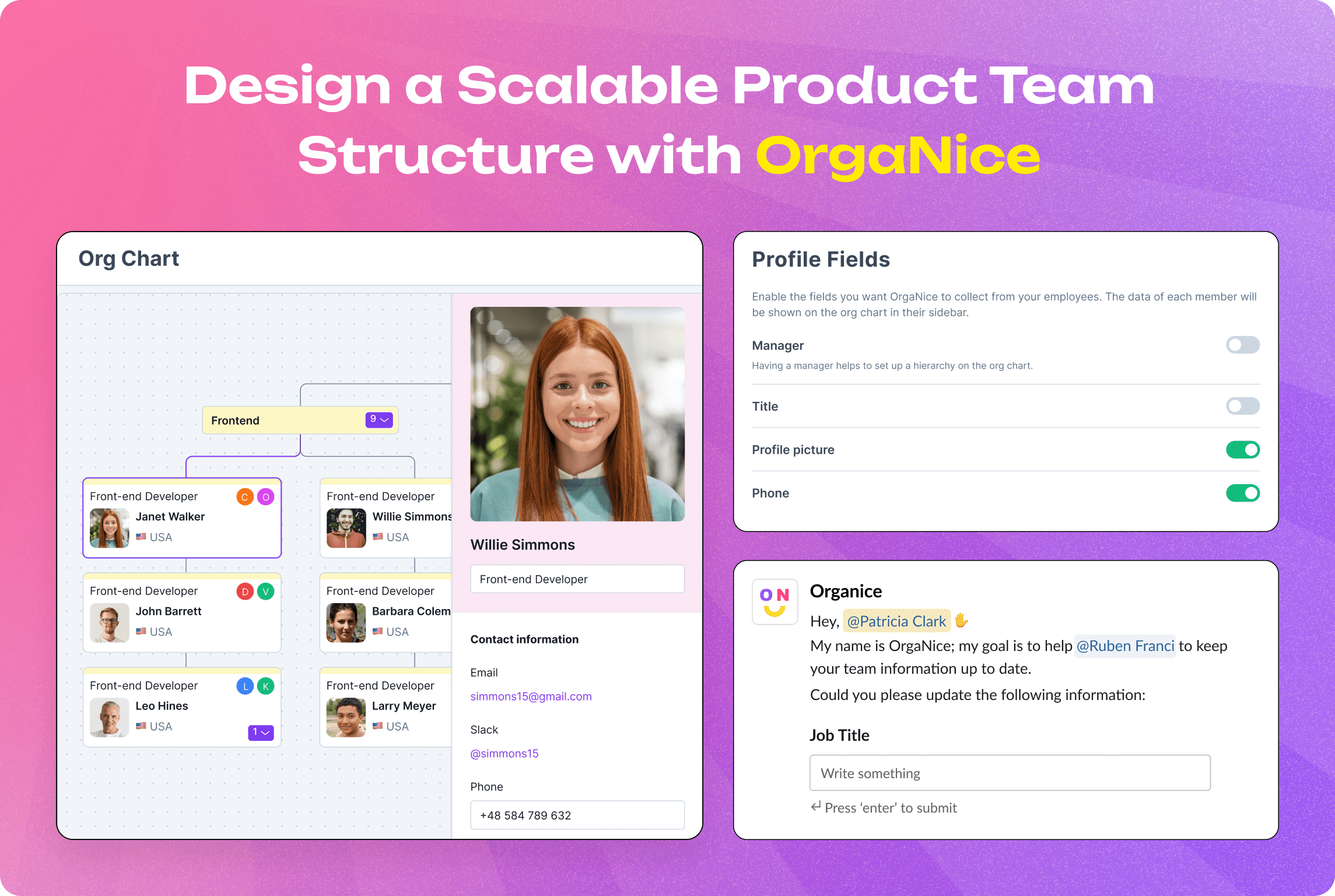
That’s why it makes sense to use a solution that takes the heavy lifting off your plate. OrgaNice is an org chart builder that lives directly inside Slack and automates almost everything. Once added to your workspace, the OrgaNice org chart bot instantly gathers all employee information and then uses its built-in AI to generate a highly accurate draft product management org chart in seconds. This eliminates the need for HR to spend time manually shaping or correcting the structure.
But OrgaNice doesn’t stop at charts. It doubles as a lightweight people-ops assistant built for Slack-first teams. It handles onboarding messages for new hires, tracks time off and vacations, sends friendly reminders to update profiles, manages birthday shoutouts, gathers feedback through quick employee surveys, and even includes a kudos system to celebrate wins. The org chart stays current automatically as people join, leave, or change roles, no spreadsheets or manual edits ever needed.
Because everything runs inside Slack, adoption is effortless. Your team doesn’t have to learn yet another tool or switch between platforms. Profiles stay accurate, HR tasks run smoothly, and your org chart always reflects the real structure of your company, not last month’s version.
Even better, OrgaNice offers a 14-day free trial, and paid plans start at just $1.25 per user per month, with extra savings on annual subscriptions. It’s a simple, affordable way to keep your org chart fresh and your people operations running on autopilot.
5. Revisit and Refine As the Product Grows
Your product team organizational structure shouldn’t stay frozen in time. As the product evolves, customer needs shift, and your company scales, the way your team is organized must evolve too. Make it a habit to regularly review whether teams can ship without constant dependencies, and whether workload is balanced across roles like PMs, designers, and engineers.
When gaps appear, refine the structure with targeted adjustments. This could mean assigning a dedicated PM to a growing feature area, splitting an overloaded squad into two, adding missing roles like a researcher or analyst, or shifting reporting lines to reflect new product lines or initiatives.
Making Your Product Team Org Structure Work Long-Term
Building a product management org structure that stands the test of time requires more than a well-defined set of roles, it calls for a living, adaptable system. As your product and company mature, revisiting workflows, refining collaboration patterns, and nurturing a culture of clarity and communication become essential. When these elements come together, the organization gains the stability and momentum it needs to evolve without losing its strategic focus.
And when it comes to keeping that structure organized, OrgaNice offers far more than a simple org-chart builder. It’s a thoughtfully designed HR ecosystem that helps teams stay connected and supported: from tracking time off and running surveys to exchanging kudos and automatically celebrating birthdays and work anniversaries. You can explore everything it offers with a free 14-day trial, and afterward continue enjoying its full capabilities at an accessible price. If any questions come up, don’t hesitate to reach out!