OrgaNice vs Workleap: Best HR Platform for Slack‑First Teams Compared
Apr 23, 2026
•
8 minutes
written by
Yauheni Svartsevich
Slack‑first teams need HR tools that match their daily workflow, not clunky dashboards. This article compares Workleap with Slack‑native tools like OrgaNice so you can choose the better fit.
Traditional HRM systems rarely align with the fast-paced nature of Slack-centric teams. Despite their extensive features, these platforms often suffer from low engagement. Employees usually prefer the ease of a direct message over navigating a complicated interface, leaving HR managers to handle manual requests that the software was supposed to automate.
Today, the market has split into two camps. On one hand, there are Slack-native solutions that live right inside your messenger, allowing you to request time off or praise a colleague without ever leaving the chat. On the other hand, there are massive ecosystems that integrate with Slack primarily through notifications, offering deep analytics and robust functionality for enterprise-level business in return.
How do you avoid making the wrong choice? Do you need a lightweight bot-app that becomes part of your company culture in five minutes, or should you invest in a full-scale platform with a bridge to Slack? To help you decide, today we’ll take a look at the popular management system Workleap and compare it with other Slack employee engagement apps.
What is Workleap?
It’s a comprehensive employee experience platform designed to help small and mid-sized businesses (SMBs) make data-driven people decisions. It functions as a powerful layer on top of a company’s core HRIS (such as BambooHR or Rippling), specifically focusing on engagement, performance, and compensation.
Workleap integrates with many popular platforms, including Google Workspace, Microsoft 365, Slack, and more. For example, in Slack, Workleap connects to automate notifications, provide access to tools, and run structured meetings, allowing HR processes to blend seamlessly into the workday. All of this simplifies work-related discussions, increases employee engagement, and reduces the need to switch between different applications.
Exploring Workleap Features
The Workleap platform is divided into three key AI‑enhanced modules:
1. Officevibe
This module focuses on deeply understanding team sentiment and preventing employee turnover. It includes:
Pulse Surveys: The platform offers both turnkey and customizable surveys to track team health in real time.
AI‑Powered Engagement Analytics: Artificial intelligence analyzes feedback, highlights key trends and issues, and provides actionable recommendations.
Recognition Tools: Built‑in features liked Vibes allow employees to publicly appreciate one another and celebrate shared wins, strengthening a culture of trust.
2. Performance
Workleap makes performance reviews frequent, fair, and transparent.
Flexible Review Cycles: Create personalized feedback workflows using customizable templates.
360° Feedback: The platform helps collect peer input for a more objective evaluation of employee performance.
Integrated 1:1 Meetings: Structured one-on-one meetings fully integrated with Slack and Microsoft Teams for seamless daily use.
Goal & OKR Tracking: Align individual growth with company-wide Objectives and Key Results throughout the year.
3. Compensation
This module helps teams make data-driven compensation decisions.
Compensation Structure: Build a consistent and fair reward system using easy‑to‑manage pay bands.
Mercer Market Data: Workleap provides access to built-in market insights from Mercer experts, enabling salary benchmarking against current market trends.
Configurable Review Cycles: Run regular compensation review cycles based on performance data and budget considerations.
AI is woven throughout the entire platform, enhancing every aspect of it. It instantly analyzes large volumes of employee feedback and delivers concise summaries of key insights for leaders. Native AI also assists managers in crafting high‑quality, constructive feedback during review cycles. Additionally, the system helps interpret what emerging trends mean for the business and highlights where intervention is needed.
4. Pingboard
It’s also worth highlighting Pingboard, one of the products within the Workleap platform. It’s a cloud-based solution for creating organizational charts and employee directories. Its core purpose is to bring transparency to a company’s structure, helping employees, especially in remote and hybrid teams, understand who is responsible for what and whom to contact for collaboration.
Pingboard offers a set of tools for visualization and planning:
Dynamic Org Charts: Quickly visualize hierarchy, department structures, and cross‑functional teams in just minutes.
Interactive Directory: Provides deep insight into employee roles and helps identify which departments are critical to day-to-day operations.
Private Planning (Planning Org Charts): A tool for leadership and HR that enables the creation of private, internal‑only org chart scenarios for modeling resource allocation and future staffing changes.
Personalized Profiles: Employees can list their unique skills and interests, making it easier to find the right experts within the organization.
Pingboard also includes features designed to strengthen connections within the team:
Who’s Who Game: Helps new employees quickly learn colleagues’ names and faces through a matching game that pairs photos with job titles.
Company Calendar: Brings together holidays, colleagues’ work statuses, and important milestones such as birthdays and work anniversaries in a single view.
Collaboration Encouragement: The platform promotes cross‑team interaction by giving employees context about what their colleagues are working on beyond their immediate groups.
Pingboard doesn’t replace the company’s core HRIS system. Instead, it makes HRIS data more accessible to everyone. It integrates easily with popular HR systems (such as BambooHR or Rippling) for automatic data synchronization, or allows teams to upload information via Excel files.
We’ve taken a detailed look at Workleap’s features; now, let’s explore how and why businesses use this platform:
Reducing employee turnover
Pulse surveys help identify early signs of employee discomfort and enable timely intervention.
Simplifying managers’ work
Instead of manually maintaining spreadsheets and documents, managers get automated tools for running 1:1s and conducting performance reviews.
Building a culture of trust
Regular feedback and recognition tools help employees feel valued and more engaged.
Providing more clarity and visibility for distributed teams
The platform helps companies visualize their organizational and team structure, providing a deeper understanding of the people who make up the workforce.
Scaling the business
Workleap supports every stage of company growth with tools that are easy to implement and don’t overload the HR team.
Fair compensation practices
Analytics and market data help eliminate salary imbalances and support transparent compensation review cycles.
Workleap sets a high standard for strategic talent management and engagement analytics, helping companies turn people data into clear signals for decision-making. But how flexible and accessible is this solution for Slack-first teams? To understand that, we need to look at alternatives to Workleap software, for example, OrgaNice, a platform built specifically for Slack.
Manage crucial HR functions without ever leaving Slack
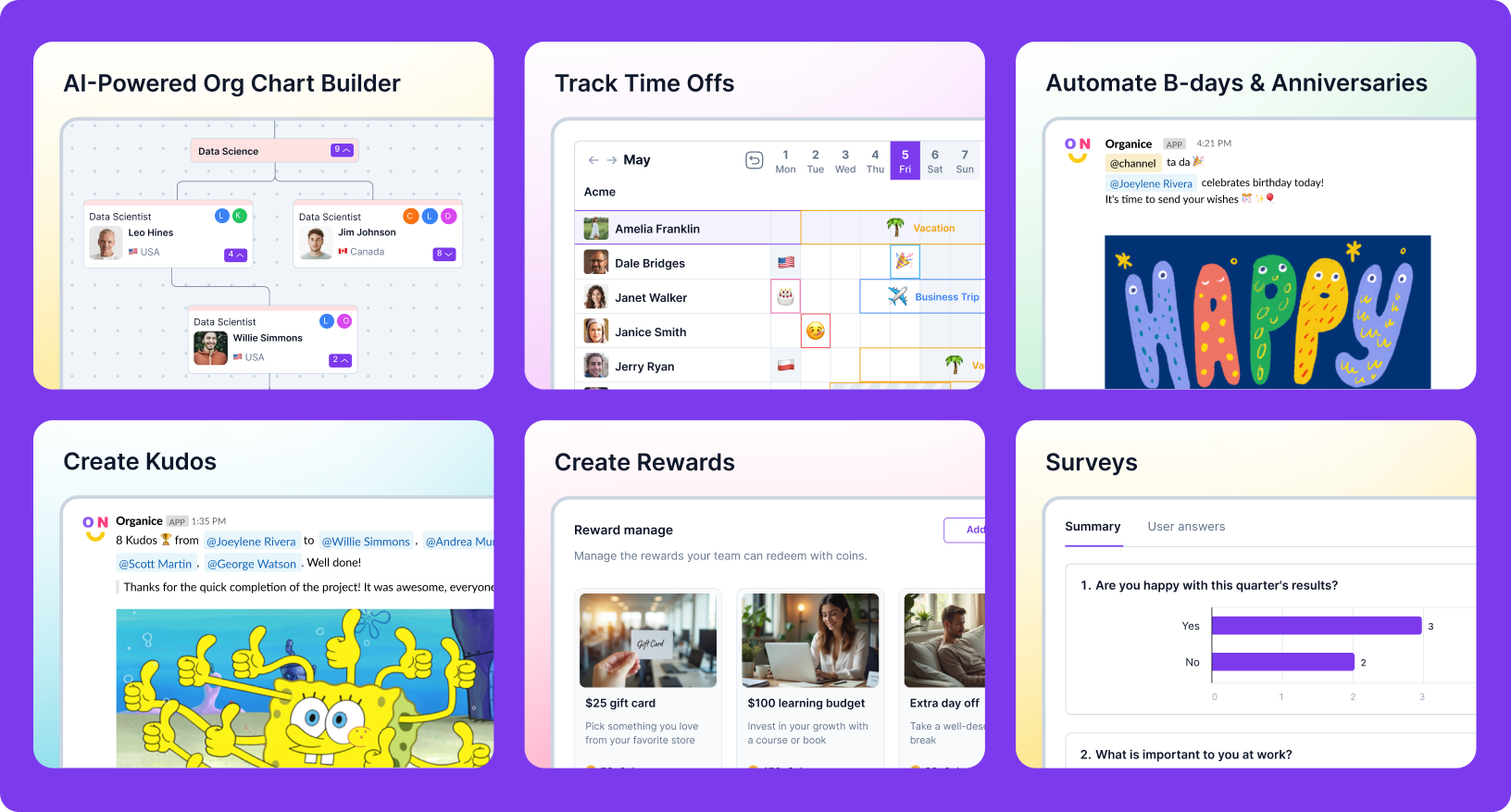
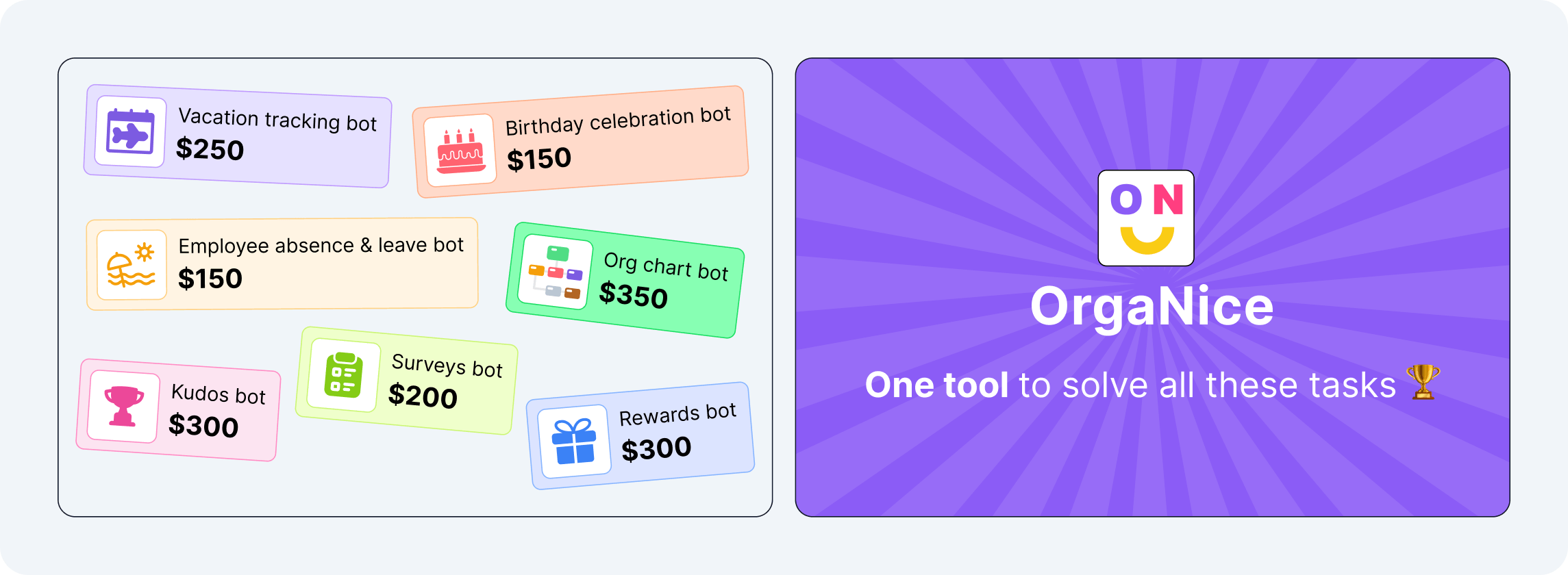
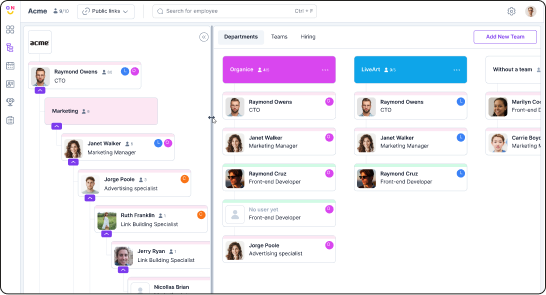
OrgaNice is an AI-powered platform built specifically for teams whose office is Slack. It turns the messenger into a full HR environment, offering an interactive org chart, a time-off tracker, peer recognition, and pulse surveys. It’s a lightweight and budget-friendly solution for teams that want to automate routine tasks (birthdays, work anniversaries, PTO, etc.) without leaving their primary workspace.
OrgaNice is used for:
Reducing administrative workload
The app automates routine tasks that managers usually spend up to 15 hours per week on, eliminating the need to maintain spreadsheets manually.
Boosting engagement
Regular surveys and recognition tools help combat employee disengagement, which statistically affects up to 77% of workers worldwide.
Creating a transparent structure
The org chart helps new hires onboard faster and enables current employees to understand colleagues’ roles and areas of responsibility.
Saving budget
OrgaNice positions itself as an affordable alternative to heavy mega-platforms, offering essential HR features for $1.25 per employee per month.
Working in a single window
With OrgaNice, there’s no need to switch between multiple tabs and apps because all core HR processes happen right where the team already works: in Slack.
OrgaNice vs Workleap: Side-by-Side Features for Slack Teams
OrgaNice is ideal for operational team management (knowing who is where, who is on leave, and how the company structure is organized) all directly inside Slack. Workleap, on the other hand, is a deeper strategic tool focused on talent development, engagement analytics, and complex compensation planning. While OrgaNice replaces administrative workload, Workleap strengthens managerial decision-making.
We’ve prepared a detailed comparison table so you can clearly see where these solutions differ and where they overlap.
Feature
OrgaNice
Workleap
Core Concept
Slack-first: an engagement and operations app built specifically for teams working in Slack.
Employee Experience: a comprehensive platform that complements existing HRIS systems.workflows.
Slack Integration
Native Experience: all tasks (time-off requests, org chart viewing, etc.) are handled directly inside Slack with no need to switch apps.
Overlay Experience: Slack is used primarily as a channel for notifications, survey reminders, and 1:1 meeting workflows.
Org Chart
Automatically generated by AI using Slack data in under 2 minutes.
Provided through the Pingboard module; supports structure visualization and resource planning.
Time-Off Tracking (PTO)
Built‑in tracker for vacations, sick leave, and remote work directly in Slack.
Not included in core modules; relies on HRIS integrations.
Performance Management
Limited to recognition (Kudos) and weekly nudges (Feedback Friday).
Full Performance module with 360° reviews, OKR tracking, and goal management.
Compensation
Not available.
Compensation module with salary management powered by Mercer market data.
Artificial Intelligence
Used for survey analysis and automatic org chart creation.
Workleap AI helps write feedback, summarizes insights, and provides recommendations for managers.
Surveys & AI
Pulse surveys and sentiment analytics directly in Slack.
Advanced pulse surveys (Officevibe) with deep AI-driven trend analysis and managerial recommendations.
Celebrations & Dates
Auto-celebrations (birthdays, work anniversaries).
Integrated into the broader recognition system and Pingboard.
Rewards
A customizable coin-based rewards system.
Not available.
OrgaNice is designed for maximum simplicity and operational efficiency inside Slack, offering essential HR features (time-off tracking, org chart, celebrations, etc.) at a very accessible price point. It’s an ideal solution for teams that want to automate routine tasks without leaving the messenger.
Workleap, in contrast, is a strategic platform focused on deep talent development, compensation analytics, and professional performance management. It is best suited for growing SMB companies that need a structured approach to people management and integrations with external HR systems.
How OrgaNice and Workleap Integrate with Slack
Let’s compare Workleap and OrgaNice in terms of their Slack integration. It represents two fundamentally different philosophies: a native experience versus an overlay experience.
OrgaNice: The Native Slack-First Experience
OrgaNice is built specifically for Slack-first teams, meaning it’s designed to turn the Slack workspace itself into a functional HRIS tool without requiring employees to leave the app. It’s easy to connect. Admins simply use the "Add to Slack" button. Once connected, all members of the Slack workspace get instant access without needing separate invites or registrations.
Employees manage regular HR tasks, such as requesting time off, viewing the team hierarchy, or giving Kudos, directly within the Slack interface. OrgaNice AI builds an interactive Org Chart by analyzing Slack directory data (titles and departments) in less than two minutes. Profile fields stay automatically synced with Slack, and information is accessible both within the OrgaNice app and the default Slack profile tab.
Workleap: The Strategic Overlay Experience
Workleap Slack integration acts as a layer on top of your existing HR technology stack, using the messenger primarily as a notification and engagement channel. Setup requires an Administrator in both Workleap and Slack. It’s configured through Settings > Provisioning, where the admin enters authentication info to establish a connection.
Workleap pulls profile data (names, emails, titles, and pictures) from Slack every 24 hours. However, a critical limitation is that Slack provisioning does not import "Direct Manager" properties, which are required for key features like Officevibe and Performance. These must be manually uploaded via bulk provisioning.
Slack is used to send engagement notifications, survey reminders, and structured 1:1 prompts. For example, users can view Officevibe feedback by typing @officevibe in a private Slack channel. While it supports structured 1:1 meetings, the core data and deep analytics typically reside within the Workleap web platform.
We’ve made a table to show you key differences at a glance:
Feature
OrgaNice
Workleap
Philosophy
Built for Slack: Messenger is the primary HR interface.
Integrated Channel: Slack is a bridge for notifications and 1:1s.
Setup
Mappings are automatic; instant access for all members.
Requires manual sync configuration and manual manager uploads.
Data Sync
Real-time sync with Slack profiles and hierarchy.
Daily (24-hour) sync of basic profile data.
User Experience
No extra apps or tabs; tasks happen in the flow of chat.
Prompts users in Slack to participate in external HR workflows.
In summary, OrgaNice is best for teams that want to centralize operational HR tasks (like PTO and Org Charts) entirely inside Slack. Workleap is better suited for organizations that need a strategic talent management platform that notifies and nudges employees within Slack to drive adoption of broader performance and engagement cycles.
Workleap vs OrgaNice: Pricing and Cost of Ownership
When choosing Slack HR tools, the economics of the project play a crucial role. Even the most advanced functionality loses its value if the cost significantly outweighs the benefit for the team, or if hidden per-employee fees drain the budget faster than you can hire people. To help you assess the transparency of your investment, we compared the pricing structures of both solutions.
Workleap Pricing
Workleap employs a per-user pricing model, where the cost depends on the selected product and the number of employees. The platform is modular, allowing companies to activate only the tools they need or combine them into bundles.
Below are the main Workleap plans and modules:
Officevibe
Priced at $5 per user per month. This module focuses on engagement pulse surveys, anonymous feedback collection, and employee recognition. Minimum team size: 10 users.
Performance
Also $5 per user per month, with a minimum of 10 users. Designed for managing performance review cycles, evaluations, and employee rating analytics.
Compensation
Priced at $5 per user per month, but requires a minimum of 100 users. Includes tools for compensation planning, managing pay bands, tracking budgets, and analyzing pay equity.
Officevibe + Performance Bundle
A combined plan offered at $8 per user per month for teams of 10+ users.
OrgaNice Pricing
OrgaNice follows a very simple and fully transparent pricing model: $1.25 per employee per month. For this price, you get the complete feature set (org chart, PTO tracking, Kudos, and surveys) with no hidden fees. A free 14-day trial is also available.
Cost Comparison for a 100-Person Slack Team
For a team of 100 people, the cost of using these apps differs significantly due to their pricing models. OrgaNice offers a single flat rate, while Workleap uses a modular system where the price depends on the selected set of tools.
Solution
Plan
Monthly
Annual
OrgaNice
All features
$125
$1,500
Workleap (Single module)
Officevibe or Performance or Compensation
$500
$6,000
Workleap (Bundle)
Officevibe + Performance + Compensation
$800
$9,600
OrgaNice is the most budget-friendly solution, allowing a 100-person team to save between $375 and $1,175 per month (depending on which Workleap modules are selected). The annual cost of OrgaNice ($1,500) is four times lower than the price of even a single basic Workleap module ($6,000).
Alongside OrgaNice, which is an excellent Workleap alternative for teams seeking simplicity and native Slack integration, there are several other strong players in the HR and performance management space:
1. Lattice
Lattice is a powerful performance and engagement platform designed to build a high-performance culture through habits like 1:1s and regular updates.
Key Features:
Structured performance review tools;
Goal and OKR setting that links individual work to company priorities;
Continuous feedback system and templates for 1:1 meetings;
Engagement surveys and pulse surveys to monitor team morale;
Lattice AI that assists managers in writing reviews and structuring feedback.
Pricing:
Pricing is calculated per employee per month and depends on selected modules. The base Talent Management module costs $11, with additional modules for Engagement (+$4), Growth (+$4), and Compensation (+$6) billed separately.
Best for:
Small and mid-sized businesses, as well as growing organizations that need structure and analytics without the complexity of enterprise-level systems.
2. Leapsome
Leapsome is a platform that helps companies manage employee development, performance, and sentiment by unifying all HR processes in one place. It combines reviews, feedback, goals, learning, and surveys to eliminate the need for fragmented tools.
Key Features:
360-degree performance reviews;
Goal and OKR management with progress visualization dashboards;
Learning Management System (LMS) with personalized development paths and growth plans;
Tools for instant feedback, praise, and 1:1 meeting tracking;
AI agents that automate admin tasks and support managers with coaching insights.
Pricing:
The platform uses a modular pricing structure based on selected features and team size. Prices are not publicly listed, a sales inquiry is required.
Best for:
Scaling companies (from 50 to several thousand employees) focused on continuous improvement rather than annual review cycles.
3. 15Five
15Five is a performance and engagement platform centered around continuous communication rather than rigid annual reviews. It helps managers and HR teams understand employee needs and progress on a weekly basis.
Key Features:
Weekly check-ins for real-time updates on wins and blockers;
AI-supported performance reviews to reduce bias and speed up review writing;
Engagement surveys with predictive analytics to identify turnover risks;
Recognition tools (High Fives) and structured 1:1 meeting support;
Outcomes Dashboard to visualize the connection between engagement and business results.
Pricing:
Uses a modular annual pricing model:
Engage ($4 per user per month);
Perform ($11 per user per month);
Total Platform ($16 per user per month).
Best for:
Mid-sized and large organizations that want to make feedback a regular habit and improve managerial effectiveness.
The Verdict
Workleap and OrgaNice solve fundamentally different problemsб and this makes the choice between them fairly straightforward once you understand your team’s context.
Workleap is a strategic, enterprise-grade HR platform. It brings together deep engagement analytics, comprehensive performance management, advanced compensation tools, and scalable talent-development processes. It’s built for growing SMBs that need a structured approach to people management and integrations with external HRIS systems. Workleap helps leaders make informed, data-driven decisions and build a mature HR function.
OrgaNice, on the other hand, is designed for teams that live in Slack. It’s a lightweight, fast, and affordable app that turns the messenger into a full HR environment: interactive org chart, PTO tracking, Kudos, surveys, and automation of routine processes. OrgaNice handles daily operational tasks, reduces administrative workload, and keeps teams aligned and engaged, all without switching between various solutions. At $1.25 per employee per month, it’s also the most cost-efficient option for teams up to 200-300 people.
Choose Workleap If
You need deep engagement analytics and AI-powered insights to support strategic decision‑making.
You’re looking for a professional tool for compensation management and market salary analysis.
You require an advanced 360-degree review system and OKR tracking integrated with your HRIS.
Choose OrgaNice If
Your team actively uses Slack, and you want to avoid switching between unnecessary tabs.
You need a fast and affordable solution to automate org charts, celebrations, and time-off tracking.
You’re a startup or SMB with a limited HR software budget and need rapid implementation.
FAQ
1. Can OrgaNice and Workleap be used together in the same organization?
Yes, OrgaNice and Workleap can be used together within the same organization to create a comprehensive HR ecosystem. While both platforms offer some overlapping features, such as engagement surveys and employee recognition, they are designed with different primary focuses that can effectively complement each other. You can use OrgaNice for time-off (PTO) tracking, viewing an AI-powered interactive organizational chart, and automating team celebrations like birthdays and work anniversaries directly in Slack. If you need compensation planning, you can integrate this Workleap module.
2. Is Workleap suitable for startups with fewer than fifty employees?
Yes, Workleap is suitable for startups with fewer than fifty employees, as it is specifically designed for growing small and medium-sized businesses (SMBs). The platform is marketed as being made for "small but mighty" teams with limited HR resources and lean budgets, helping them act on engagement and performance signals early.
However, startups should be aware that the Compensation module requires a minimum of 100 users, so that specific feature would not be available for teams with fewer than fifty employees.
3. How long does implementation take for OrgaNice compared to Workleap?
OrgaNice can be set up within minutes directly through Slack, and its AI will generate your org chart in under two minutes. Workleap, being a more comprehensive system, requires a slightly longer configuration process and often includes a demo and guided onboarding to ensure proper synchronization with your HRIS.
4. Do OrgaNice and Workleap offer free trials before purchase?
OrgaNice provides a 14-day free trial. This allows Slack-based teams to explore its full suite of features, such as the AI-powered org chart, the time-off tracker, and the Kudos recognition system, without an immediate financial commitment. The free trial must be requested separately through the bot.